Palletizing
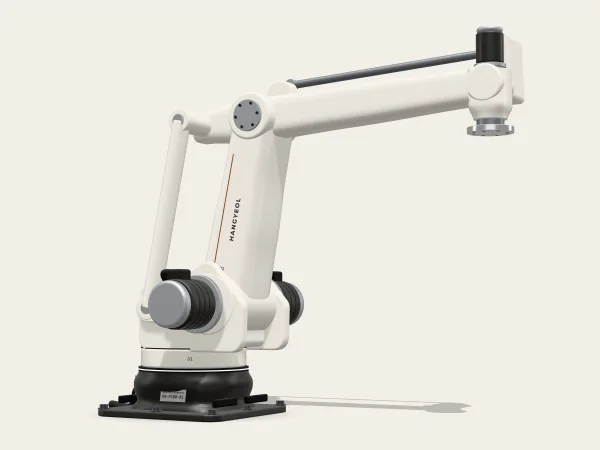
HG-P180-31
A 4-axis palletizer, 180 kg and 3,100 mm, running 1,800 cycles an hour at the end of the line
- Payload
- 180kg
- 397 lb
- Reach
- 3,100mm
- 122 in
- Repeatability
- ±0.05mm
 Asher Kim Portfolio №02 · This is a fictional company. No real quotes, orders, or consultations. · Fictional company
HG-DWG-000 · Hangyeol Robotics website
Application 2 of 8
The robot picks cases at the end of the conveyor and stacks them layer by layer. Each layer interlocks with the one below, so the load holds together in transit.
Process sequence
Scroll down and each step lights up in copper on the plate.
Packed cases arrive on the conveyor and stop at the pick point.
Cases are turned or paired to match the layer pattern.
A vacuum gripper lifts the case by its top.
It places each case to the pattern and lays a slip sheet when a layer is full.
The full pallet rolls out and an empty one rolls in.
Design points
Interlocking layers keep the load stable before it is wrapped. Hangyeol Studio builds the pattern from the case and pallet sizes.
Picking one case or two at a time changes throughput more than anything else. We size the gripper first, from case weight and dimensions.
Light curtains guard the forklift exits. When someone steps in, work on that side stops.
Recommended robots
Palletizing is hard on the back: the same heavy case, thousands of times a day. Hand it to a robot and people move on to pallet changes and line supervision.
The HG-P180-31 is a four-axis parallel-link arm, so the wrist always stays level. The gripper never tilts, which keeps vacuum pads and clamps simple. Put a pallet station on each side and it keeps stacking while one is swapped.
For lower-volume lines, the HG-C25-17 cobot fits. It takes little floor space and sits on a single pedestal at the end of the conveyor.
Palletizing
A 4-axis palletizer, 180 kg and 3,100 mm, running 1,800 cycles an hour at the end of the line
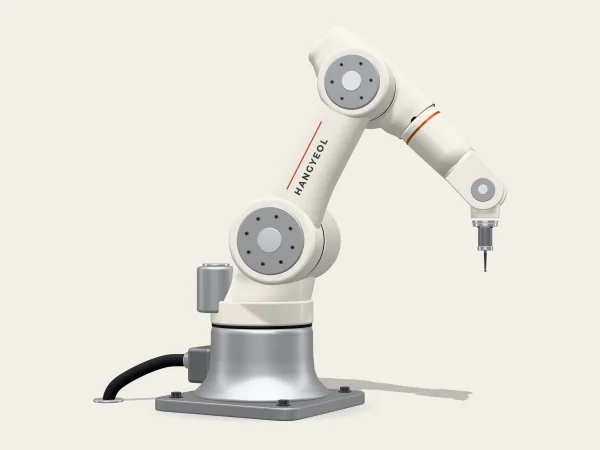
Collaborative robots
Our largest cobot: 25 kg and 1,700 mm for end-of-line palletizing and large-part tending
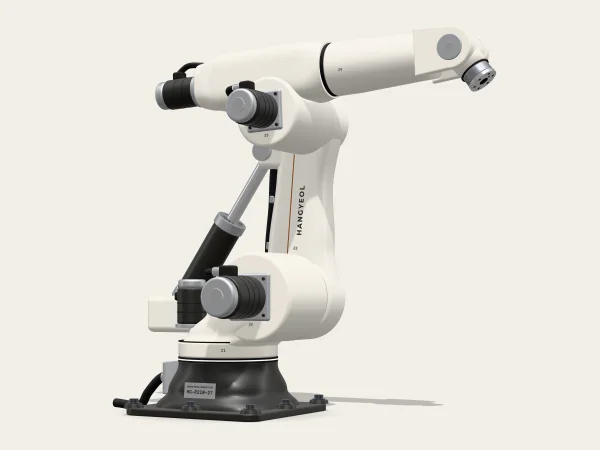
Industrial 6-axis
A 210 kg, 2,700 mm heavy-duty arm for body parts and battery packs
Cases
Anseong, Gyeonggi · Food plant
HG-P180-31 × 2
1,140casesCases per hour, two robotsExample
Industries that use this process most
Share part drawings or a video of the current process. An application engineer will work through the cell layout and cycle time with you.