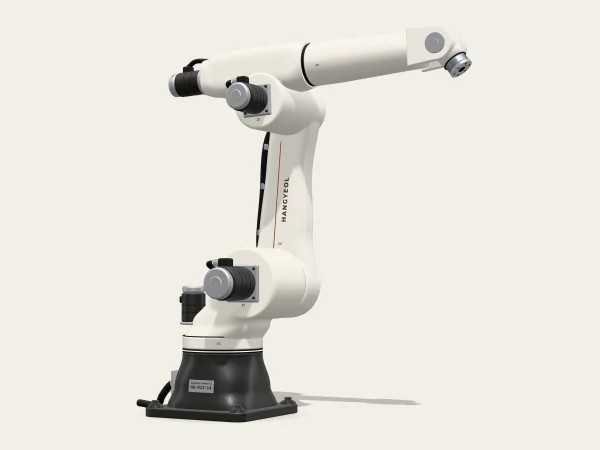
Industrial 6-axis
HG-R12-14
A 12 kg, 1,400 mm mid-size arm for arc welding and small-part handling
- Payload
- 12kg
- 26 lb
- Reach
- 1,400mm
- 55.1 in
- Repeatability
- ±0.02mm
 Asher Kim Portfolio №02 · This is a fictional company. No real quotes, orders, or consultations. · Fictional company
HG-DWG-000 · Hangyeol Robotics website
Application 1 of 8
The torch weaves along the joint as it travels. The tighter the repeatability, the more even the bead and the less rework.
Process sequence
Scroll down and each step lights up in copper on the plate.
An operator loads parts into the fixture and closes the clamps.
The rotary table turns 180° and presents the parts to the robots.
The torch tip touches off the part to find where the seam actually is.
The robot weaves along the seam at the set angle and speed.
It clears spatter from the nozzle and trims the wire before the next part.
Design points
A robot that repeats to ±0.02 mm cannot help if the part shifts in the fixture. We place the clamps with the weld heat in mind.
Stamped parts vary from piece to piece. Touch sensing finds the seam and shifts the program to match.
We enclose the cell with fencing and welding screens and add fume extraction. A light curtain guards the loading side.
Recommended robots
Arc welding suits parts with many joints: seat frames, brackets, and structures. The robot drags the torch at the same angle and speed every time, which takes out most of the bead-width variation of manual welding.
A typical cell pairs a rotary fixture table with two robots. While the robots weld on one side, an operator loads parts on the other. For spot welding on body parts, a gun goes on the HG-R210-27.
The HG-C10-13 cobot fits high-mix, low-volume welding. You teach weld points by guiding the arm by hand, so changeovers are quick.
Industrial 6-axis
A 12 kg, 1,400 mm mid-size arm for arc welding and small-part handling
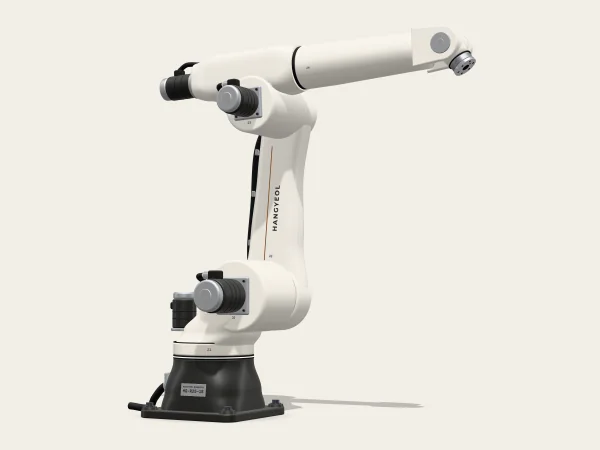
Industrial 6-axis
A 25 kg, 1,800 mm arm for heavier torches, grippers, and wider work areas
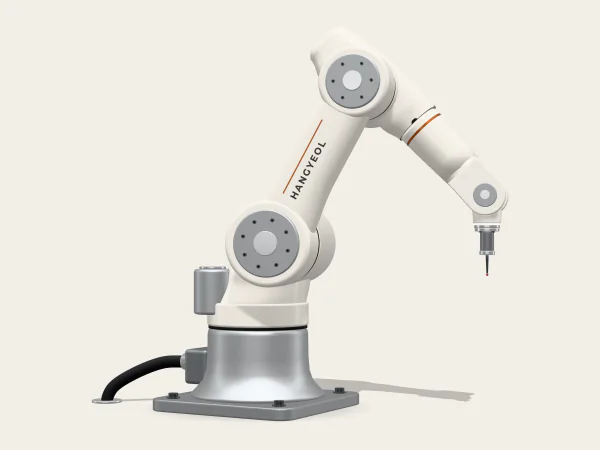
Collaborative robots
Our flagship cobot: 10 kg and 1,300 mm, from machine tending to welding
Other models that fit
Cases
Gyeongsan, Gyeongbuk · Automotive seat-parts maker
HG-R12-14 × 4
19%Shorter cycle timeExample
Industries that use this process most
Share part drawings or a video of the current process. An application engineer will work through the cell layout and cycle time with you.