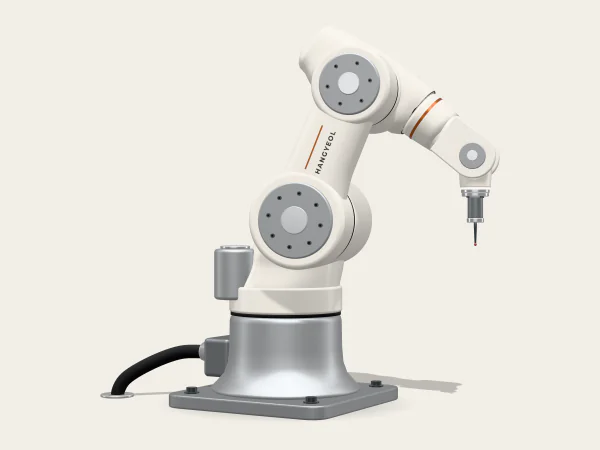
Collaborative robots
HG-C16-10
16 kg and 1,000 mm: a cobot for heavy tools in screwdriving and tending
- Payload
- 16kg
- 35 lb
- Reach
- 1,000mm
- 39.4 in
- Repeatability
- ±0.05mm
 Asher Kim Portfolio №02 · This is a fictional company. No real quotes, orders, or consultations. · Fictional company
HG-DWG-000 · Hangyeol Robotics website
Application 5 of 8
The robot moves down to each hole, drives the fastener to torque, and moves on. Torque and angle are logged for every bolt, so a missed one is caught on the spot.
Process sequence
Scroll down and each step lights up in copper on the plate.
The fixture clamps the part as it arrives on the conveyor.
A feeder delivers bolts to the tool tip one at a time.
A camera confirms the hole position and the tool lines up.
The tool drives to the set torque and angle, and the values are logged.
Records and images for every bolt are checked before the part moves on.
Design points
The fastening reaction goes straight into the arm. Choose payload and joint size from the tool’s maximum torque.
Tightening in a cross pattern keeps the part from warping. The sequence follows your fastening standard.
Torque and angle for every bolt are stored against the product serial number. If an issue surfaces later, you can pull that unit’s record right away.
Recommended robots
The biggest risk in fastening is one missed bolt. People miss them when they tire, while a robot visits every hole in the programmed order. If the torque or angle from the nutrunner falls out of range, that bolt is flagged at once.
Heavy nutrunners call for the HG-C16-10 cobot. Its heavier joints take the fastening reaction, and a camera on the same wrist lets the cell check its own work.
For electronics with many small screws, use the HG-S10-70 SCARA. Its 300 mm Z stroke reaches the floor of deep housings.
Collaborative robots
16 kg and 1,000 mm: a cobot for heavy tools in screwdriving and tending
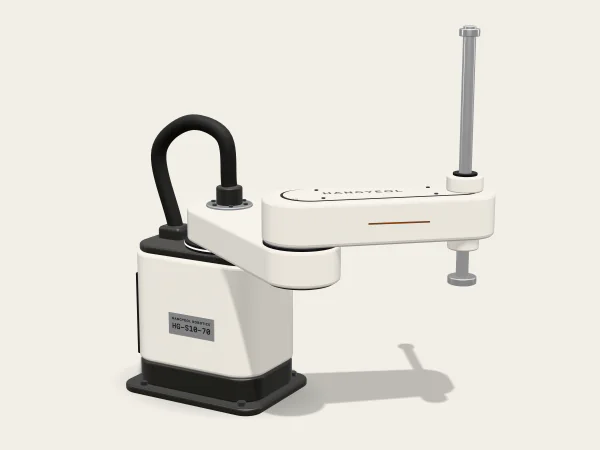
SCARA
A 700 mm SCARA for up to 10 kg, built for heavier assembly and screwdriving
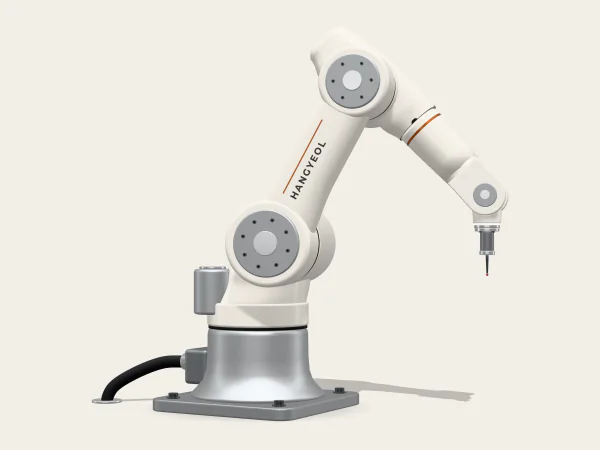
Collaborative robots
Our flagship cobot: 10 kg and 1,300 mm, from machine tending to welding
Other models that fit
Cases
Ochang, Chungbuk · Battery module maker
HG-C16-10 × 6
0boltsMissed fastenings, first 3 monthsExample
Industries that use this process most
Share part drawings or a video of the current process. An application engineer will work through the cell layout and cycle time with you.