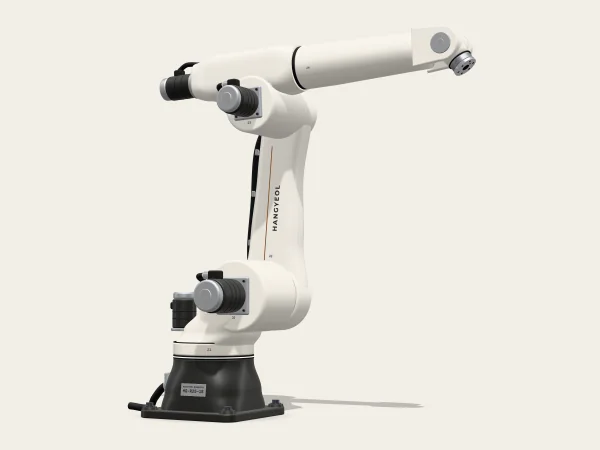
Industrial 6-axis
HG-R25-18
A 25 kg, 1,800 mm arm for heavier torches, grippers, and wider work areas
- Payload
- 25kg
- 55 lb
- Reach
- 1,800mm
- 70.9 in
- Repeatability
- ±0.02mm
 Asher Kim Portfolio №02 · This is a fictional company. No real quotes, orders, or consultations. · Fictional company
HG-DWG-000 · Hangyeol Robotics website
Application 6 of 8
The tool presses on the surface with constant force and makes overlapping passes. Hold that force steady, and the finish comes out even.
Process sequence
Scroll down and each step lights up in copper on the plate.
The part goes into the fixture against its datum surfaces.
The tool touches down lightly to find the real surface.
It sands in overlapping passes at the set force.
After a set number of parts, the abrasive is replaced.
Design points
Part dimensions vary. Hold the force rather than the position, and the surface comes out even.
Too little overlap leaves stripes, and too much costs time. Start at about half the tool width and fine-tune with trial runs.
Place the extraction duct close to the tool and fit the robot with a protective cover.
Recommended robots
Grinding and deburring are dusty, noisy, high-vibration jobs, and every person presses a little differently. A robot holds the same force under force control and repeats the same overlapping path.
HG-C cobots measure and hold contact force with the torque sensors in all six joints. For heavy tools or large parts, fit an HG-R25-18 with a force sensor.
A sanding cell always includes dust extraction. Worn abrasives are changed automatically at an exchange station.
Industrial 6-axis
A 25 kg, 1,800 mm arm for heavier torches, grippers, and wider work areas
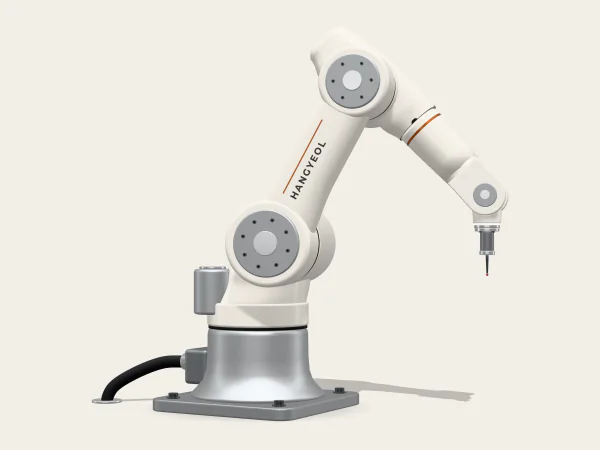
Collaborative robots
Our flagship cobot: 10 kg and 1,300 mm, from machine tending to welding
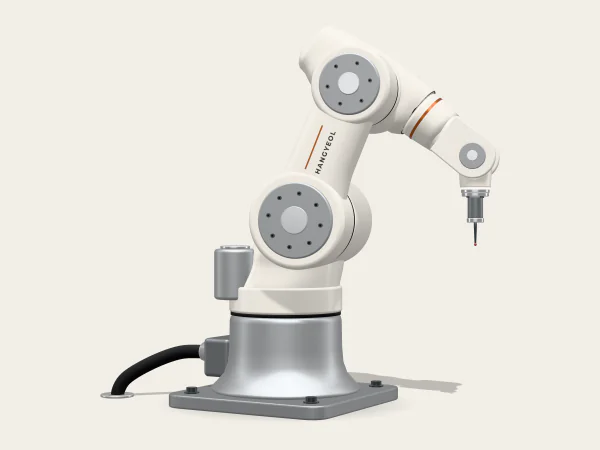
Collaborative robots
16 kg and 1,000 mm: a cobot for heavy tools in screwdriving and tending
Other models that fit
Cases
We have not published a case for this process yet. Here are plants in the same industries that run Hangyeol robots.
Gyeongsan, Gyeongbuk · Automotive seat-parts maker
HG-R12-14 × 4
19%Shorter cycle timeExample
Changwon, Gyeongnam · Precision machining shop
HG-C10-13 × 3
9hoursUnattended night runExample
Industries that use this process most
Share part drawings or a video of the current process. An application engineer will work through the cell layout and cycle time with you.