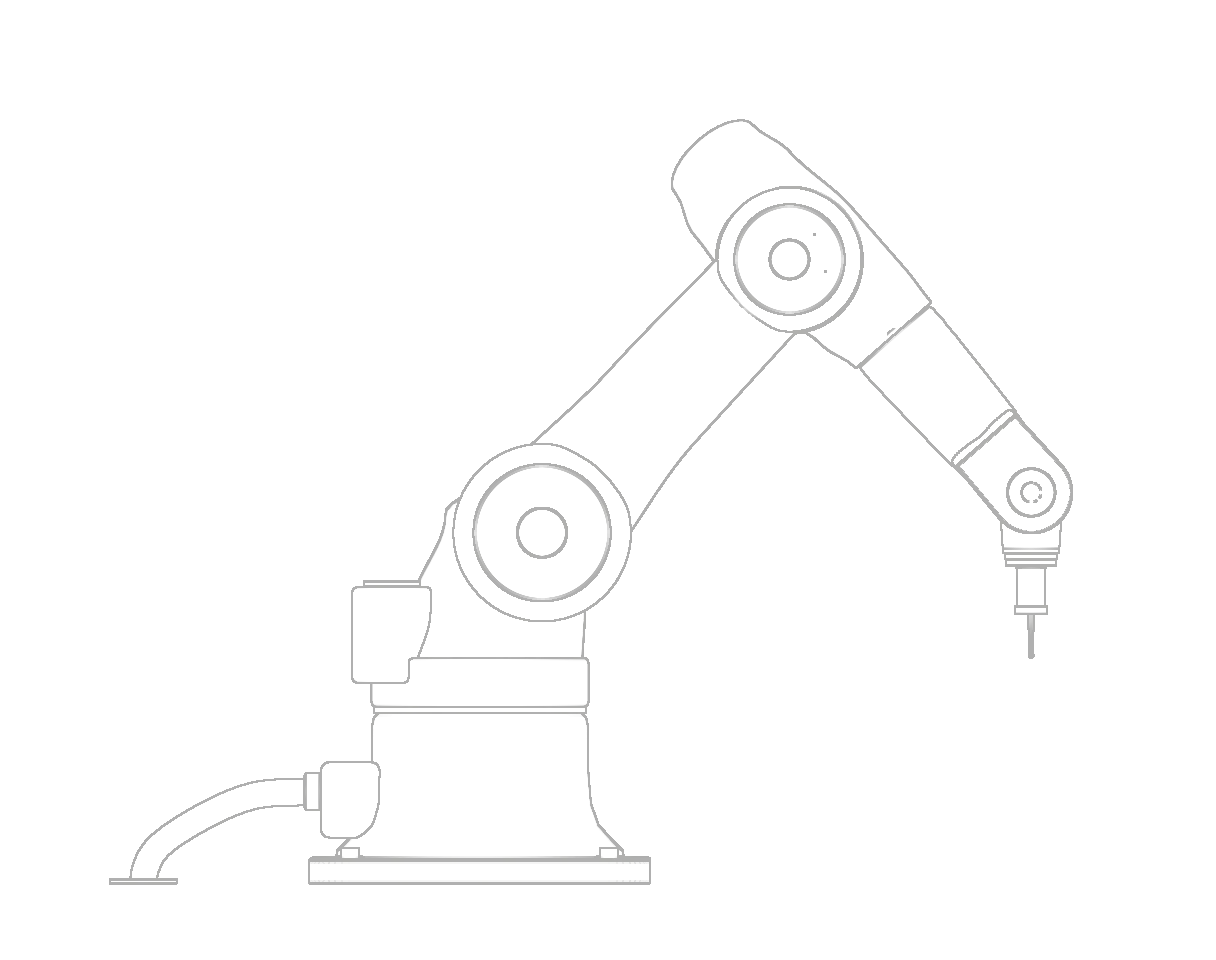


01WeldingA tight zigzag
The torch weaves along the joint as it travels. The tighter the repeatability, the more even the bead and the less rework.
 Asher Kim Portfolio №02 · This is a fictional company. No real quotes, orders, or consultations. · Fictional company
HG-DWG-000 · Hangyeol Robotics website
Hangyeol Robotics has designed and built industrial robots in Daegu, Korea, since 2009. We draw every part ourselves, down to the inside of each joint.
Design, assembly, and shipping all happen under one roof at our Dalseong plant. The 4,800 robots we have delivered so far are at work in 23 countries.
Our name comes from the Korean word hangyeol-gatda: steady, unchanging. Since we started building welding cells in a small shop in Daegu in 2009, one standard has guided us. Tens of thousands of moves later, the robot should still land on the spot it hit the first time.
We fit each one with a motor, a reducer, a torque sensor, a brake and an encoder. Each joint measures its own load and stops itself if anything is off.
18 safety functions · ISO 13849-1 PL d / Cat. 3
After tens of thousands of moves, it lands within ±0.03 mm of the same point. The thin lines trace every path the tool has taken. The paths vary a little. The point does not.
A robot for collaborative applications. A risk assessment is required before installation.
A dual encoder reads the angle on both the motor side and the output side, on the same board as the motor driver. The two readings are checked against each other, and the joint stops if they disagree.
When power is cut, springs press the plates together and hold the joint where it is. The arm does not sag in a power outage.
A stator wound with copper and a permanent-magnet rotor. With no housing of its own, it sits right inside the joint and keeps the joint short and light.
An elliptical cam flexes a thin toothed cup into the teeth of the outer ring. The teeth mesh with no play, which holds repeatability to ±0.03 mm.
Strain gauges on the spokes measure the load on the joint. Since our second-generation cobots in 2026, all six joints have one.
Crossed rollers carry loads from several directions at once. The upper arm bolts to the outer flange.
Cables run through the hollow shaft, so they never twist as the joint turns. With no exposed cables, the body is sealed to IP66.
This browser cannot draw 3D, so the story is shown as still images.
Process paths
The same arm draws a different path for every process. We draw the path from your shop drawings first, then tune the cell to repeat it exactly, tens of thousands of times.
See all eight applicationsThe torch weaves along the joint as it travels. The tighter the repeatability, the more even the bead and the less rework.
The robot picks cases at the end of the conveyor and stacks them layer by layer. Each layer interlocks with the one below, so the load holds together in transit.
The robot pauses at the door, goes straight in to set the blank in the chuck, and comes back out the same way. It keeps machines running through the night.
Up from the pick point, across at a fixed height, and down onto the place point. The move can last 0.3 s or span the whole plant.
Product lineup
From a compact SCARA to a palletizer that lifts 180 kg, every robot is drawn at its true relative size. All thirteen models run on the HGC-7 controller and the HGT-12 teach pendant.
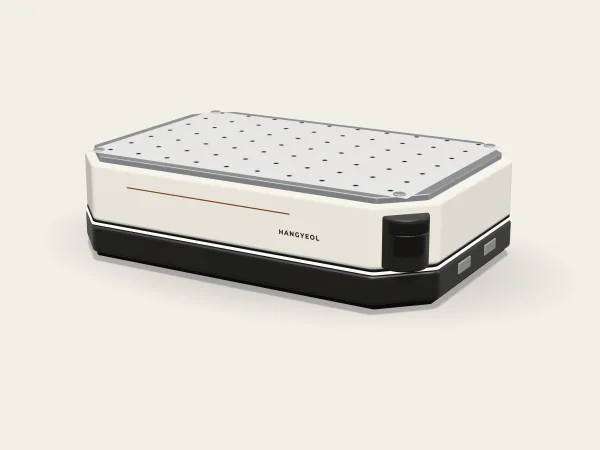
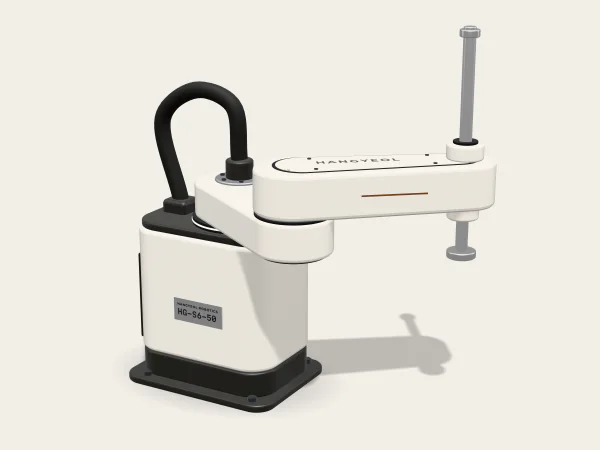
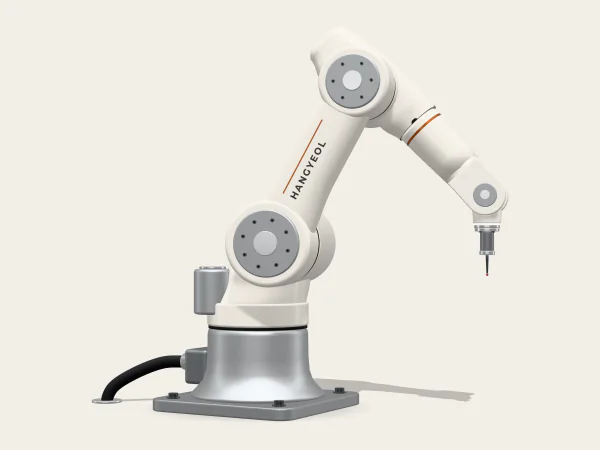
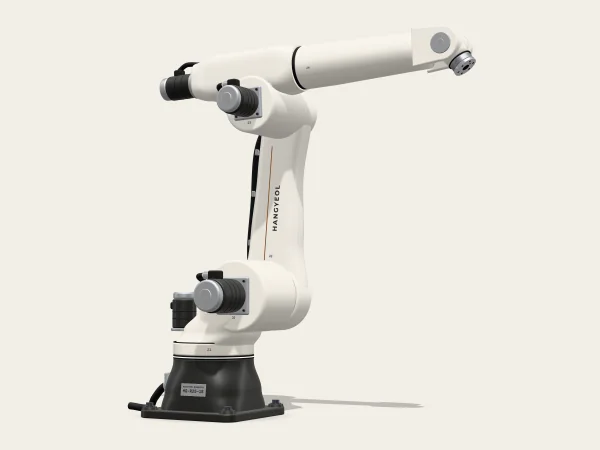
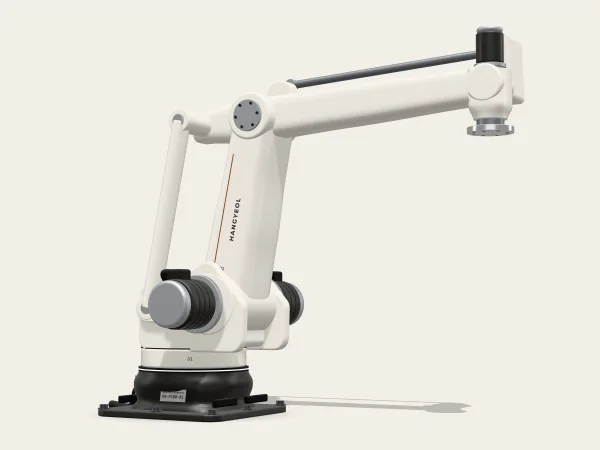
HG-M2 models
Autonomous carts for 600 kg loads
HG-S3 models
Fast horizontal transfer and assembly
HG-C4 models
6-axis arms for collaborative applications
HG-R3 models
Articulated arms for welding and handling
HG-P1 model
1,800 cycles an hour
Case studies
Records from welding, bolting and palletizing lines. Each card carries a top-down plan of the cell layout.
All case studiesGyeongsan, Gyeongbuk · Automotive seat-parts maker
HG-R12-14 × 4
19%Shorter cycle timeExample
Ochang, Chungbuk · Battery module maker
HG-C16-10 × 6
0boltsMissed fastenings, first 3 monthsExample
Anseong, Gyeonggi · Food plant
HG-P180-31 × 2
1,140casesCases per hour, two robotsExample
These cases are examples made for this portfolio. Customers are not named, and every figure is an example compared with the same process before automation.
Hangyeol in numbers
We test the repeatability of every robot before it ships and file the record under its serial number.
Seven steps to a working cell
Durations are examples. They depend on the cell size, the number of robots, and your site schedule.
How we work, step by stepTypical time 1–2 weeks
You receiveProcess requirements sheet
Typical time 2–3 weeks
You receiveCell layout, cycle time report, quote
Typical time About 1 week
You receiveContract, schedule, acceptance criteria
Typical time 4–10 weeks, depending on the cell
You receiveFinal inspection record, factory acceptance record
Typical time 3 days to 2 weeks
You receiveInstallation record
Typical time 1–4 weeks
You receiveCommissioning record, safety settings
Typical time 3–5 days
You receiveTraining certificates, handover documents
Bars show each step on the same 0–10 week scale.
News
Every one of the six joints now has its own torque sensor. All four models, from the HG-C5-09 to the HG-C25-17, move to the new generation.
Seventeen years after we started in a small factory in Daegu, Hangyeol robots now work in 23 countries.
An autonomous mobile robot that carries 600 kg (1,323 lb) between processes on its own. The HG-M600C, with an HG-C10-13 cobot on top, launches with it.
Send us the workpiece, the process and your target cycle time, and an engineer will contact you within one business day. You can also run our robots yourself in the showroom at our Dalseong headquarters.